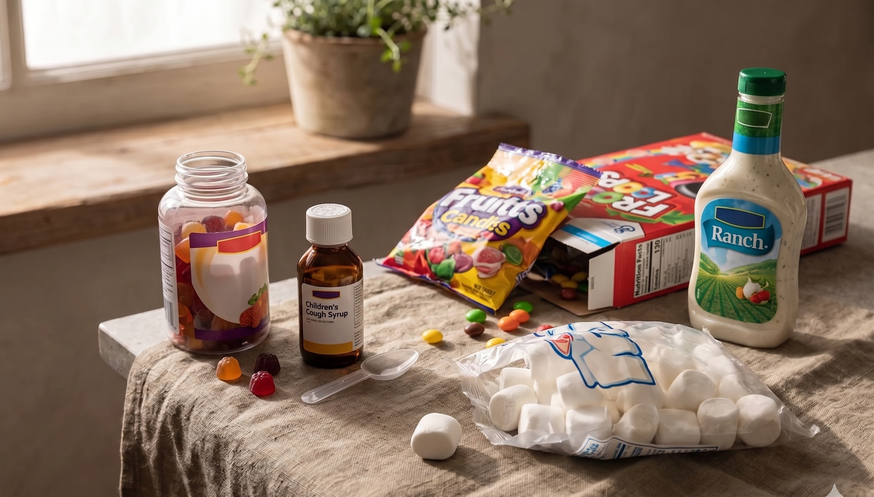
If you’ve ever asked yourself, why do I have cravings even though I’m not hungry , especially after promising you’d “be good”, this may feel uncomfortable to hear: cravings are not a character flaw.
They are signals.
Learning how to reduce cravings isn’t about overpowering your brain or ignoring your body. It’s about understanding why patterns repeat, why a 28-day diet works for a while, and then old habits slowly return.
The issue isn’t willpower. It’s signaling.
Your nervous system, hormones, and metabolism are constantly communicating. When those signals are unstable, behavior follows. When they’re supported, behavior changes more naturally.
Let’s walk through what is actually happening.
Why do I still have cravings even when I’m eating healthy?
This is one of the most frustrating experiences for women I work with. You clean up your diet. You cut sugar. You increase vegetables. And yet, the food cravings are still there.
Here’s why.
Habits run through a loop: cue → craving → response → reward, as James Clear explains Cravings are part of a neurological process, not a moral one. When a cue appears (stress, fatigue, boredom), your brain anticipates relief. The craving is simply a motivational signal.
Neuroscientist Andrew Huberman describes dopamine as being tied to motivation and craving, not just pleasure. In other words, your brain isn’t “weak.” It’s wired to seek reward when something feels off balance.
On top of that, ultra-processed foods have been shown in controlled settings to drive higher calorie intake, even when nutrients are matched.
In a randomized inpatient trial published in Cell, participants consumed about 500 calories more per day on an ultra, processed diet compared to an unprocessed one.
That isn’t willpower. That’s biology interacting with food design.
So if you’re eating “healthy” but your internal signals are still unstable, the issue may not be food quality alone. It may be signaling stability, blood sugar, satiety hormones, nervous system load, that hasn’t fully recalibrated yet.
Not all cravings are physiological hunger. Some are situational impulses, social environments, evening routines, or stress cues.
CaloCurb Clinical is designed to support impulse regulation in those moments, explains Cravings pause between cue and response. It doesn’t replace nourishment. It supports decision space. And that space is often where long, term change becomes possible.
Why am I hungry again an hour after I eat?
Many women describe this pattern:
- You eat a meal.
- You feel okay.
- An hour later, you’re back in the kitchen.

This isn’t necessarily overeating. It can reflect disrupted hunger control.
Research from large precision, nutrition studies like PREDICT 1 (published in Nature Medicine) shows that people have dramatically different metabolic responses to the exact same meal. Glucose, insulin, and triglyceride responses vary widely between individuals.
That means your signals are personal.
If blood sugar rises and falls quickly, hunger can return rapidly. If sleep has been short, and a meta,analysis in Obesity Reviews shows short sleep is associated with changes in appetite hormones like leptin and ghrelin, your body may amplify hunger signals the next day.
Hunger isn’t failure. It’s feedback.
Fullness isn’t just about stomach volume. It’s about gut,brain communication.
When microbio failures and fiber intake support satiety hormones appropriately, hunger control becomes more predictable. GutGlow™ was formulated to support that gut, driven fullness layer , helping reinforce the signaling pathways that tell your brain a meal was sufficient. For many women, stabilizing this layer reduces the need to rely on restraint later in the day.
When appetite control feels unpredictable, the solution isn’t to eat less. It’s to stabilize the physiology driving the signal.
If I’m focusing on protein for fat loss, why don’t I feel more satisfied?
Protein matters. But context matters more.
Many women increase protein for fat loss and expect it to automatically quiet cravings. Sometimes it helps. Sometimes it doesn’t.
Why?
Muscle building and satiety signaling depend on more than just grams. Muscle protein growth is influenced by amino acid profile, leucine content and micronutrient cofactors.
Reviews in the American Journal of Clinical Nutrition suggest that leucine plays a key role in stimulating muscle protein synthesis, though the optimal amount can vary by age, dose, and context.
If protein intake is inconsistent, low in essential amino acids, or not paired with sufficient micronutrients, the signaling effect may be blunted.
Lean mass acts like metabolic infrastructure. Protein quality and micronutrient cofactors influence more than muscle tone, they influence signaling.
Many protein powders focus primarily on macronutrient totals, grams of protein, calories, and sometimes sugar content.
But muscle protein synthesis depends on more than just hitting a protein number. It depends on amino acid composition, leucine availability, and the metabolic cofactors that help translate intake into signaling.
Without sufficient essential amino acids, particularly leucine, and supportive micronutrients like magnesium, zinc, chromium, and B vitamins, the signaling effect can be incomplete. You may be “hitting your macros” and still not fully stimulating the metabolic infrastructure that supports steady energy and hunger control.
SolFuel® Physique was built around this principle: full amino acid transparency, meaningful leucine content, and metabolic support designed to reinforce that signaling layer, not just provide grams.
When muscle protein synthesis is supported consistently, energy steadiness improves. And when energy steadies, hunger control becomes less reactive and more rhythmic.
Protein for fat loss is helpful. Protein that supports muscle signaling is more powerful.
Transparency matters. If a protein powder does not disclose its full amino acid profile, it’s difficult to evaluate whether it meaningfully supports muscle signaling.
Why do my food cravings get worse when I’m stressed or exhausted?
Stress changes everything.
When you’re overwhelmed, your nervous system shifts into survival mode. Dopamine reward, seeking can intensify. Blood sugar can fluctuate. Sleep shortens.
Tony Schwartz writes that managing energy, not just time is what drives sustainable performance. When energy is depleted, your body seeks quick fuel.
This is adaptive. Not broken.
Short sleep has been associated with changes in appetite, regulating hormones. Stress and fatigue alter how your brain interprets reward. So the louder cravings after a long day? That’s your system trying to rebalance.
For many women, this shows up as a very specific pattern, especially in the evening. If you’ve ever found yourself wanting something crunchy or intensely textured at night, that’s not random.
I wrote more about this pattern in Why do I crave crunchy food at night?, where we unpack how stress, sensory input, and nervous system fatigue converge after a long day.
The answer is not more restriction. It’s more regulation.
When stress is high, appetite rhythm often becomes unpredictable. The nervous system drives urgency, and hunger cues can feel louder or more impulsive. This is where targeted support can matter. Sculpt™ was designed to help stabilize appetite rhythm and metabolic signaling during stress, not by suppressing hunger, but by supporting the biological pathways that influence how intense those signals feel.
When the nervous system is steadier, cravings often soften without force.
Is it normal that appetite control feels harder in my 40s and 50s?
Yes.
Muscle mass naturally declines with age. Hormonal fluctuations alter metabolic tone. Recovery demands increase.
If lean mass decreases, resting metabolic rate can shift. If sleep is disrupted during perimenopause, appetite signals can amplify.
And remember: studies show wide individual variability in metabolic responses. Your experience may not look like your friend’s, even if you eat similarly.
Appetite control isn’t static. It evolves.
That doesn’t mean it’s hopeless. It means cravings biology is personalized, and the strategy for appetite control must evolve too.
Am I under, supporting muscle building without realizing it?
Many women in their 40s and 50s under, eat relative to their muscle needs, especially during stress.
When muscle protein synthesis is not consistently stimulated, lean mass can decline gradually. Over time, that affects metabolic tone, glucose regulation, and hunger control.
Supporting muscle building isn’t about bulk. It’s about infrastructure.
Muscle acts as a glucose reservoir. It improves insulin sensitivity. It stabilizes energy output. And when energy stabilizes, cravings often quiet.
This is one reason metabolic support must go beyond calories and macros. It must consider signaling layers.
How to reduce cravings without white-knuckling every evening
Now we return to the central question: how to reduce cravings in a way that doesn’t feel like a fight.
Three principles matter:
- Stabilize blood sugar through balanced meals that combine protein, fiber, and whole foods.
- Support muscle and metabolic tone, not just calorie targets.
- Protect sleep and recovery, because hunger control is tightly linked to rest.
Ultra-processed foods have been shown to increase energy intake even when macronutrients are matched. So food quality matters. But so does consistency.
Habit research suggests it takes far longer than 21 days to solidify new patterns, one study from University College London found habit formation varied widely, with a median around 66 days.
Signals take time to recalibrate.
Reducing cravings naturally is less about elimination and more about stability. When cues no longer trigger emergency-level responses, the loop softens.

What would it feel like if my signals were finally stable?
It wouldn’t feel dramatic.
It would feel calm.
You would eat and feel satisfied. Hunger control would feel predictable. Evening food cravings would be quieter, not gone forever, but manageable.
Energy would feel steady. Not perfect. Steady.
And you would no longer feel like you’re negotiating with your own brain and body.
What if the solution isn’t a single product, but a regulated system?
The women who see the most sustainable change aren’t chasing one magic fix.
They’re supporting signaling across layers:
- Gut driven fullness
- Metabolic and muscle support
- Appetite rhythm
- Impulse awareness
- Daily habit reinforcement
This is why a coordinated system, like the SolFuel approach integrating Sculpt™, Physique, GutGlow™, CaloCurb™, and the Solaris 365 tracking and habit forming app, focuses on infrastructure rather than quick suppression.
It’s not about stopping cravings by force.
It’s about making them quieter so you can follow through on the healthy habits you have always strived to do consistently.
No single layer determines whether cravings feel manageable or overwhelming. Appetite rhythm, gut signaling, muscle support, impulse awareness, and daily habit reinforcement all interact.
The SolFuel System integrates Sculpt™, Physique, GutGlow™, CaloCurb Clinical, and the Solaris 365 app to support those layers together.
It’s not about chasing symptoms. It’s about stabilizing the infrastructure that shapes them. When signaling is supported consistently, behavior begins to align more naturally.
The Takeaway
You are not weak.
You are not broken.
You are not lacking discipline.
Cravings are communication.
When you learn to interpret and support the signals, brain, gut, hormones, muscle, behavior shifts naturally. Not overnight. Not perfectly. But steadily.
And that shift begins not with control, but with understanding.
If you’re ready to support your signals instead of fighting them, explore the SolFuel® System. Each layer , Sculpt™, Physique, GutGlow™, CaloCurb Clinical, and Solaris 365 , was designed to work together to stabilize appetite rhythm, metabolic signaling, and habit integration.
Not sure which signaling layer needs the most support right now? Take the Cravings Quiz for personalized guidance.
You don’t need more discipline. You need infrastructure that helps your biology work with you.
Shop the SolFuel® System
Take the Cravings Quiz
About the Author:
Stephanie Solaris is a chemical engineer and applied functional medicine expert specializing in metabolic health, hormones, cravings, and sustainable weight loss for women over 35. Her work combines systems biology, clinical insight, and research, backed nutrition to support the body’s natural signaling systems.
Learn more about Stephanie → About Stephanie