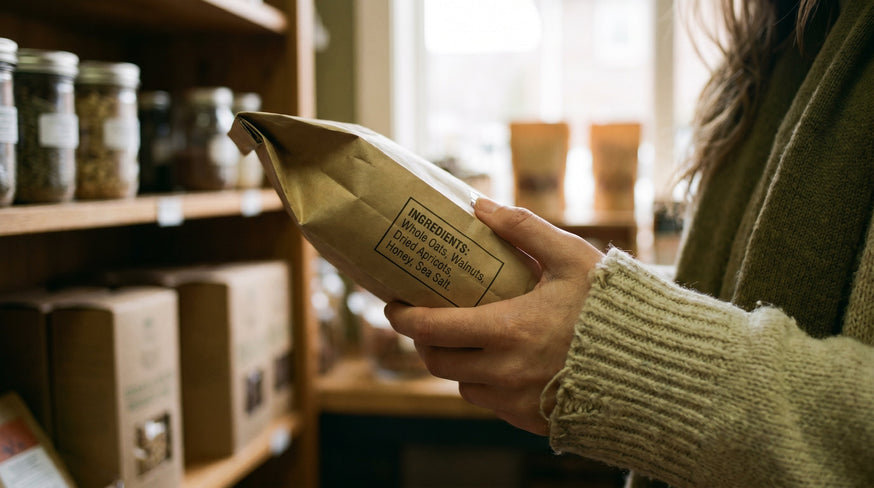
On April 22, 2025, the FDA announced what most of us never expected to hear: the agency is phasing out nine petroleum-based synthetic food dyes by the end of 2026. Yes — the dyes that make M&Ms bright blue, your gummy vitamins red and orange, your Gatorade green, and your birthday cakes yellow. Red 3 was already banned in January 2025; eight more are coming next.
If your first reaction was, “Wait. What was wrong with them and why were they allowed all this time?” — that response is accurate, not paranoid. Synthetic food dyes are petroleum-derived colorings used purely for cosmetic effect, and the research now ties them to gut barrier disruption, microbiome shifts, low-grade inflammation, and the brain fog, mood drift, and cravings that follow.
Your gut has been carrying this load for years. The policy is finally catching up to the science.
If food dyes are this bad, why didn’t anyone tell me sooner?
The honest answer is: people did. You just weren’t told by the right system.
The European Union has required warning labels on dye-containing foods since 2010 — Tartrazine, Sunset Yellow, Allura Red AC (Red 40), and three others must note that they may affect activity and attention in children. Norway banned most synthetic food dyes outright in 1978 — 48 years before the U.S. began catching up. In May 2025, China mandated that food colorings be made from fruits, vegetables, plants, or algae normally consumed as food, leapfrogging the FDA’s voluntary 2026 deadline.
A 2009 watchdog database showed Blue 1 already banned in Belgium, France, Germany, Switzerland, Sweden, Austria, and Norway. Red 40 was banned in those same countries plus Denmark.
The information was out there. It was just easy to miss while everyone was sorting through every other food label that mattered — gluten free, organic, non-GMO, BPA free, sugar free. Each of those was earned for a reason.
Meanwhile, over the last 70 years, our food stream has continued to be re-engineered. Easier farming and higher yields meant lower costs at the register. Our demand for less time in the kitchen, quick pick-me-ups, longer shelf life, and more variety reshaped what manufacturers made. And the better the package looked, the more we bought. The synthetic compounds, colorings, preservatives, and additives came along for the ride — many of them designed to make food look brighter and more appetizing on the shelf so you’d buy more.
When we started learning that those same modifications were creating the wrong signals in the body — that’s a longer story for another post. [Future internal link: Food Stream Evolution blog] For this article, the part that matters is the gut.
Where exactly were these food dyes — and how much was I really exposed to?
Yes, they are still hiding in places most people would never check — and the FDA’s phase-out is voluntary and staggered over years, not weeks. Awareness, not panic, is the move.
A few places these dyes show up that catch most people off guard:
Farmed salmon. Wild salmon get their pink from krill. Farmed salmon would be gray without supplementation, so producers add astaxanthin or canthaxanthin to feed.
-
Astaxanthin is naturally occurring — it is the same red pigment found in krill, salmon, and lobster, and is sold as a human antioxidant supplement.
-
Canthaxanthin is synthetic in the form used in fish feed, though it is also found naturally in some mushrooms. The EU restricted canthaxanthin’s use in poultry and fish feed due to retinal deposit concerns in humans who consumed too much.
So if you are eating a lot of farmed salmon produced in countries outside the EU, read the label. “Color Added” is usually the only signal you will get.
I don’t want to ‘name names,’ but here are some other items that need your attention:
Children’s pain reliever and cough syrups. A 2020 toxicology analysis found that a single dose of some children’s syrups can deliver two to three times the FDA’s Acceptable Daily Intake of Red 40. Most major brands offer dye-free versions; they simply do not market them as the default.
Gummy vitamins. Often contain Red 40, Blue 1, and Yellow 6 — sometimes at twice the ADI for Red 40 per serving.
White marshmallows, dill pickles, some toothpastes, many “fruit” yogurts and more. Blue 1 neutralizes natural yellow tones; Yellow 5 keeps pickles bright; dyes deepen the look of blueberry bits.
Walk into your kitchen tonight and look at five labels you have not read in years. Notice — do not judge. Just notice.
How did food dyes affect my gut — and is this why I feel the way I do?
You walk into the kitchen at 3 p.m., scattered and a little foggy, and reach for something you didn’t plan to eat. Then later, you wonder why.
Here is what the research now shows. In a 2022 Nature Communications study, chronic exposure to Allura Red AC (Red 40) disrupted intestinal barrier function in mice, elevated colonic serotonin, altered the gut microbiota, and increased susceptibility to colitis. The McMaster researcher who led the work called the dye a possible dietary trigger for inflammatory bowel diseases.
The FDA itself acknowledged something similar in 2003. An advisory on Blue 1 used in enteral feeding solutions warned that patients with increased gut permeability may face greater risk of metabolic acidosis. Translation: when the gut barrier is already compromised, this dye is dangerous. The implication for the rest of us — gut barriers quietly under load — deserves more attention than it has received.
The 2009 Solaris handout flagged Yellow 5 as a coal-tar derivative linked to hyperactivity, ADD, asthma, and migraines, noting that some schools saw children’s behavior shift after banning Tartrazine-containing snacks.
If you have been carrying mid-afternoon brain fog, irritability, or cravings you cannot explain — your body has been giving you information. This is the gut-brain inflammation pattern I first wrote about in depth back in 2020.
What I learned about food dyes in 2009 — and why I’ve been talking about them ever since
Long before MAHA, before the 2026 phase-out, before the Consumer Reports surveys showing 72% of Americans concerned about synthetic dyes — there was Foodfacts.com.
I was running Solaris Whole Health, my own functional health practice. At the same time, I was part of the team at Foodfacts.com, helping develop the information that powered the platform — a novel idea at the time, with the tag “What’s really in your food.” It was science-backed, not rumor-driven, and exactly the kind of work my engineer’s brain wanted: pattern recognition, ingredient by ingredient.
What I learned there, I brought back to my clients. I wrote one-page handouts they could keep on the fridge, and pointed them to Foodfacts.com to go deeper. The information was rigorous, and rare for its time — anywhere I could give people the most credible information I knew how to give, even when the material wasn’t yet mainstream. As a chemical engineer, it was simply how I was wired.
Here is a line from one of those 2009 handouts, verbatim:
“It is literally industrial waste.”
That was 2009. It was sourced to the U.S. FDA, the Center for Science in the Public Interest, and the UK FoodGuide — the same sources cited in food-dye articles today.
The scale, even then, was visible:
|
Dye |
Products in 2009 Database |
Featured Products from the Handout |
|
Blue 1 |
2,076 |
Gatorade Frost; Jell-O Cook & Serve Chocolate Fudge Pudding |
|
Red 40 |
3,061 |
Pillsbury Moist Supreme Yellow Cake Mix; Jell-O Cook & Serve Chocolate Fudge Pudding |
|
Yellow 5 |
2,699 |
Pillsbury Moist Supreme Yellow Cake Mix |
Most of these products are still on shelves in 2026.
None of this was hidden. It just wasn’t being told in the places most people were listening.
But the FDA is phasing them out — why does this still matter?
Three quick answers:
1. The phase-out is voluntary and staggered. Companies have until end of 2026 — and “phase-out” doesn’t mean “recall.” Existing inventory continues to sell. Your pantry is the buffer between the announcement and the actual reformulation.
2. Past exposure doesn’t unwind itself. The dyes are leaving the shelves, but the inflammation, microbiome disruption, and gut barrier damage already in your body still needs repair. The body forgets nothing without help.
3. The replacements are coming, and not all of them are safe by default. Natural colorings (beet, paprika, turmeric, annatto) are a real improvement — but the same regulatory system that allowed petroleum dyes for 70 years isn’t suddenly rigorous. New synthetic alternatives are already in development. The pattern won’t stop with these 9.
Reference — the 9 food dyes being phased out (and where they hide):
|
Dye |
FDA Status |
Where It Commonly Hides |
|
Red 3 |
Banned January 2025 |
Maraschino cherries, some pediatric medicines, certain candies |
|
Citrus Red 2 |
Authorization being revoked |
Florida orange peels (color enhancement) |
|
Orange B |
Authorization being revoked |
Hot dog and sausage casings |
|
Green 3 |
Phasing out by end of 2026 |
Canned vegetables, mint candies, some sodas |
|
Red 40 |
Phasing out by end of 2026 |
Skittles, M&Ms, Doritos, Mountain Dew, Pop-Tarts, Yoplait Trix yogurt, Hawaiian Punch |
|
Yellow 5 |
Phasing out by end of 2026 |
Dill pickles, Mountain Dew, Pop-Tarts, Skittles, Twinkies, sweet relish |
|
Yellow 6 |
Phasing out by end of 2026 |
Doritos, Cheetos, Sunkist Orange, Kraft Creamy French dressing |
|
Blue 1 |
Phasing out by end of 2026 |
Gatorade, white marshmallows, Pop-Tarts, gummy vitamins, mouthwash |
|
Blue 2 |
Phasing out by end of 2026 |
Skittles, M&Ms, some candies, pet food |
3 ways to repair gut damage after decades of food dyes in our pantries
Recognition is the first half of agency. The second half is action that does not require becoming the household ingredient police.
A few real-life starting points:
1. Read five labels a week, not fifty. Build the muscle without burning out.
2. Pick two or three swap categories that match your family’s actual habits — cereal, candy, dressings, beverages. Many major brands already produce dye-free or naturally colored versions for export markets. Ask for those.
3. Support the gut that has been carrying the load. Synthetic dyes inflame the intestinal lining; low-grade inflammation disrupts the gut-brain conversation that governs satiety and cravings. Repair starts with fiber, fermented foods, and prebiotics that feed the microbes ultra-processed diets quietly starve.
This is also where supplement quality matters. Supplements are concentrated food — which is why we are so particular at Solaris about what goes into ours, and what does not.
This is where SolFuel® GutGlow™ fits naturally. Where a single-strain Akkermansia probiotic delivers one specific organism in a capsule, GutGlow™ works the other way — a synergistic, microbiome-first prebiotic fiber blend that feeds Akkermansia and the wider community of beneficial strains lowered by UPF-heavy diets. As those fibers ferment, the short-chain fatty acids they produce help support the intestinal barrier and the GLP-1 and PYY satiety side of the gut-brain loop. Not one strain delivered in isolation — the gut ecosystem that strain needs to thrive.
How long does gut repair take?
Meaningful change tends to show up in months, not days. The exact arc depends on what else is happening in the body — ongoing stress, sleep quality, what else is on the plate, how long the gut has been under load. The science is clearer on direction than on a precise calendar.
The dyes are coming off the shelves because the science finally caught up to what our bodies have been telling us for decades — but the gut that has been carrying that load still needs support to repair.
Want the practical version? Download the one-page companion handout — the foods still on shelves with the dyes the FDA is phasing out, and what to use instead until the bans take full effect.