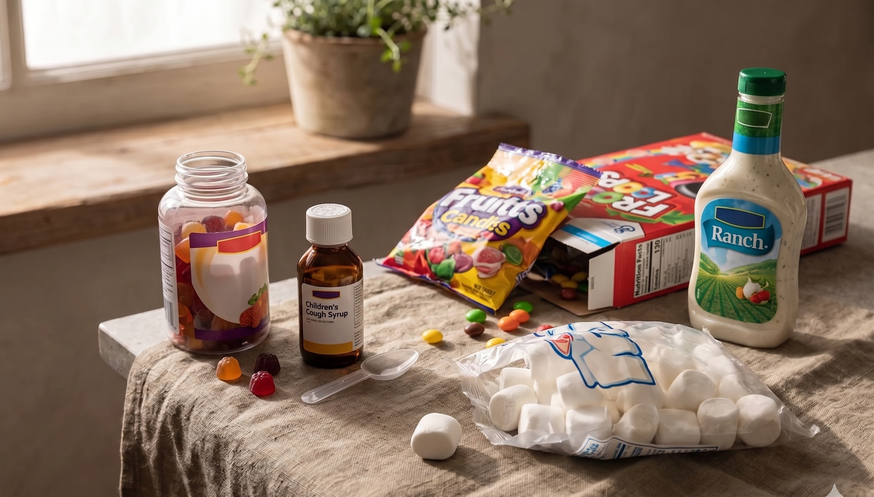
Ultra-processed food cravings are not a willpower failure. They are the predictable biological response to food engineered to bypass your satiety signals — including most of the organic, gluten-free, and GMO-free foods marketed as “healthy.”
There is a specific kind of frustration in being the woman who is doing everything by the new wellness playbook and still standing in front of the open pantry at 9:30 at night. You read the labels. You bought the organic granola. You picked the gluten-free crackers. You spent extra on the protein bar with the “clean” ingredient list.
And you’re still hungry.
The honest answer is: probably nothing is wrong with you. Something is wrong with the food. And there’s new evidence for it.
You Bought the Healthier Version. Why Are You Still Hungry?
I see this pattern often in my practice. And in August 2025, a study in Nature Medicine made it unmistakable.
University College London ran a randomized crossover trial. Same people. Two diets. Both ad libitum (eat as much as you want). Both followed national healthy-eating guidelines. The only thing that changed was processing level.
Both Groups:
Same daily calories.
Same daily macros.
Same nutrition guidance.
The only thing that changed was processing level.
|
Group A (Minimally Processed) |
Group B (Ultra-Processed) |
|
Plain yogurt with fruit |
Flavored yogurt cup |
|
Steel-cut oats with fruit |
Flavored instant oatmeal packet |
|
Home-cooked whole-grain breakfast |
Packaged “whole grain” breakfast cereal |
|
Cooked chicken and vegetables |
Frozen ready meal from a service (e.g. Daily Harvest) |
|
Whole fruit |
“Clean” protein bar |
|
↓ ~2× the weight loss |
↓ Roughly half the weight loss |
Weight outcome: Group A eating minimally processed food lost roughly twice the body weight of the ultra-processed arm.
This is the data point that explains why the work you’ve been doing isn’t working — and why that’s not your fault.
Can Organic and Gluten-Free Foods Still Be Ultra-Processed?
Yes. Organic and gluten-free certifications regulate what an ingredient is and how it was grown — not how it was processed. A product can be 100% USDA-certified organic, 100% gluten-free, and still meet every criterion for ultra-processed food.
Here’s the two-layer reality:
Organic certification governs the growing phase. No synthetic pesticides, no GMOs, no synthetic fertilizers. It does not govern how the food is processed once those ingredients leave the field. An organic granola bar can contain organic maltodextrin, organic natural flavor, organic emulsifiers, organic cane sugar — and still be UPF. The “organic” stamp protects you from one set of problems. It does not protect you from another.
Gluten-free is more nuanced. Removing gluten from baked goods requires structural binders to do the work gluten normally does. That means gluten-free baked goods often contain more additives than their wheat counterparts: xanthan gum, guar gum, modified starches, dough conditioners, stabilizers.
An organic gluten-free chocolate chip cookie can easily have 18 ingredients to a regular homemade cookie’s 7.
And this is where the conversation needs to be more careful than it usually is. For someone who is sensitive to gluten or celiac, “just eat wheat again” isn’t an option. So the real question is not should I eat gluten-free food? It is which gluten-free choices are actually causing problems, and which are not?
The 8-Ingredient Test below answers that question. The short version: there are three additives to flag, and two that are doing necessary work in gluten-free baking that you don’t need to worry about.
So What Kind of “Healthy” Foods Are UPFs?
This is the part most articles skip. You’ve been told organic and gluten-free aren’t enough — fine. But which specific foods on your grocery list actually cross over into UPF? Here are the categories that catch most people off guard.
|
Category |
Likely UPF (check the panel) |
Not UPF (NOVA-1 / minimally processed) |
|
Yogurt |
Flavored cups, low-fat fruit yogurts, plant-based flavored yogurts |
Plain Greek, plain whole-milk, plain skyr |
|
Granola & cereal |
Boxed granola, “healthy” cereals (even organic), granola bars |
Plain rolled oats, steel-cut oats, plain European-style muesli, homemade granola |
|
Protein products |
Protein bars, protein cookies, protein chips, flavored protein powders |
Whole-food protein. Clinically formulated protein powder that passes the 8-ingredient test. |
|
Oatmeal |
Flavored instant packets |
Plain rolled or steel-cut oats |
|
Snack foods |
Veggie chips, lentil chips, chickpea puffs, “clean” crackers |
Plain nuts, plain seeds, plain dried chickpeas (unflavored), whole fruit |
|
Plant-based meat |
Beyond, Impossible, most packaged “plant burgers” |
Beans, lentils, tofu, tempeh |
|
Beverages |
Flavored nut milks, oat milks with gums and oils, flavored sparkling waters, most kombucha |
Water, plain tea, plain coffee, plain unsweetened nut milk with 2–3 ingredients |
|
Frozen meals |
“Clean” frozen pizzas, “healthy” frozen entrées |
Plain frozen vegetables, plain frozen fruit, plain frozen fish |
|
Bread |
Most packaged GF bread, most “whole grain” sandwich bread |
-Sourdough from a local bakery, true whole-grain loaves with 3–5 ingredients, and -Verified packaged GF brands that pass the 8-ingredient test (e.g., products like Canyon Bakehouse) |
The pattern: plain, single-ingredient foods almost always stay in the NOVA-1 (minimally processed) category. The moment something is flavored, packaged, or engineered for shelf life, check the panel. That’s where the line usually sits.
And a note on the foods people often ask about: plain dried chickpeas are not UPF. Plain Greek yogurt is not UPF. Plain nuts are not UPF. It’s the flavored, seasoned, sweetened, and engineered-for-convenience versions that cross the line. Don’t let this article scare you off the actual good foods.
Why the UPF Label Is Confusing the Conversation
The NOVA-4 ultra-processed bucket lumps a Pop-Tart, an infant formula, a clinical nutrition shake, and a plant-based burger into the same category. Your body doesn’t respond to those the same way. That’s the reason the public conversation about UPFs feels confusing right now.
Monteiro and his team created NOVA in 2009 to answer a specific question:
"Why were Brazilians getting sicker even as their nutrition labels looked ‘fine’?" — the question that built NOVA, Monteiro 2009
Traditional Brazilian foods — rice, beans, fresh produce — were being displaced by packaged products. The standard nutrition labels weren’t predicting chronic disease anymore. The level of processing was.
The system works well at the population level. It’s much less useful in the grocery aisle. Biology says a Pop-Tart and a clinical nutrition shake aren’t equivalent — and Monteiro himself has acknowledged the category has real limitations.
So the rest of this article leans on the specific mechanisms the research has actually identified — not the NOVA label.
What the data has made unambiguous:
-
Approximately 70% of packaged food in the U.S. supply is ultra-processed, per a July 2025 FDA estimate.
-
Children get over 60% of their calories from it.
And that share is unevenly distributed. If you’ve felt like you’ve been swimming upstream — here’s part of why. The UPF problem isn’t evenly distributed across zip codes:
-
UPF runs 65 to 70% of calories in lower-income U.S. communities.
-
Closer to 45% in higher-income ones.
The reasons aren’t about willpower. They’re about pricing, time, geography, and marketing:
-
Pricing: UPF inputs (corn, soy, wheat) are heavily subsidized, lowering cost per calorie.
-
Time: time poverty leaves less room for cooking.
-
Geography: lower-income neighborhoods have fewer full-service grocers.
-
Marketing: UPF brands target those zip codes far more aggressively.

How UPFs Actually Affect Your Body: The 3 Mechanisms
Ultra-processed foods affect your body through three specific mechanisms: a satiety failure, gut microbiome disruption, and a reward pathway hijack. Here’s what each one looks like, with a concrete food example.
1. The satiety failure.
In a 2019 NIH inpatient study published in Cell Metabolism, people put on an ultra-processed diet ate about 508 extra calories per day. They didn’t know they were eating more. Their bodies just didn’t feel full. Kevin Hall and his team ran two diets matched for calories, sugar, fat, fiber, and sodium. The only difference was the processing level.
The Johns Hopkins Bloomberg School of Public Health explained why in November 2025:
Industrial processing makes food softer, faster to eat, and easier to digest — altering your “fullness” signal before it can fully reach your brain.
So you might ask yourself – is that why I can eat a whole bag of non-grain, gluten free chips in a sitting? That altered structure overrides natural fullness signals and dampens satiety hormone response — PYY, GLP-1, leptin. Compare an apple to apple juice from concentrate. Same fruit. Same sugar grams on the label. Completely different signals to the body.
2. The gut microbiome disruption.
The emulsifier in your gluten-free bread is making you feel less full, faster. Here’s why: ingredients like carboxymethylcellulose (CMC) thin the protective mucus lining inside your gut, which starves the bacteria that produce the chemicals telling your brain you’ve had enough. Less of those chemicals = your fullness signal never lands.
The evidence: in August 2025, Wellens and colleagues published the first human randomized trial on dietary emulsifiers in Clinical Gastroenterology and Hepatology (linked source). CMC — used in everything from ice cream to gluten-free bread to salad dressing — significantly lowered short-chain fatty acid production in the gut. Short-chain fatty acids are how your gut talks to your brain about fullness, mood, and metabolic regulation. When they drop, that conversation gets quieter.
And it’s worth saying clearly: these additives exist for real reasons — shelf life, texture, factory speed. We are now learning the costs we didn’t see at the time.
I love Bob’s Red Mill products — I have for years. But until I read the 2025 studies, I was reaching for their flavored gluten-free instant oatmeal packets out of pure convenience. Same brand. Different product. One ingredient on the plain rolled oats canister. A long list on the flavored instant packets. Once I understood the difference, I didn’t stop buying Bob’s. I just changed what I was buying. That’s the test — not the brand, the panel.
Same brand, three product tiers:
-
Bob’s Red Mill GF Rolled Oats (canister): one ingredient. Clean.
-
Bob’s Red Mill GF Quick-Cooking Oats: still rolled oats, slightly more processed. Clean.
-
Bob’s Red Mill GF Instant Oatmeal Packets (flavored): natural flavors, evaporated cane sugar, salt, sometimes gums. Likely fails the 8-ingredient test.
Same brand. Three product lines. Three different classifications. Read the panel, not the logo.
That’s what’s happening in your gut. Now to the brain.
3. The reward pathway hijack.
Research from Ashley Gearhardt and colleagues at the University of Michigan has found that ultra-processed foods meet the same scientific criteria used to classify tobacco as addictive. About 14% of adults and 12% of children show signs of UPF addiction on the Yale Food Addiction Scale — a validated screening tool used in this research.
“I can’t stop at one cookie” isn’t a character flaw. It’s a fast carb-and-fat delivery system hitting your dopamine receptors at a speed real food never reaches. UPFs deliver carbs and fats to the brain faster than whole foods can, engaging the same reward circuits researchers have studied in addictive substances. On imaging, the dopamine activation patterns look similar to those seen with other addictive substances.
Three mechanisms. One outcome — the cravings volume goes up, and your ability to turn it down goes with it:
-
Satiety failure — the food doesn’t signal you to stop.
-
Microbiome disruption — the bacteria that would produce the stop signal can’t.
-
Reward hijack — the dopamine response is spiked above what real food normally reaches.
Turning the cravings volume down starts with changing the inputs.

The 8-Ingredient Test — What to Look For
If it comes in a box, a bag, or a can — here are only the eight ingredients to scan for. Thirty seconds, no app required.
3 - Sweetener Flags:
-
Sucralose, acesulfame potassium, aspartame. Research has linked these artificial sweeteners to gut microbiome and glucose tolerance changes — including a 2022 paper in Cell by Suez and colleagues showing measurable shifts in healthy adults.
-
Maltodextrin. A cheap carb bulker disguised as a thickener. High glycemic index. Some research suggests it can feed certain pathogenic gut bacteria.
Next group — the additives that mess with your gut lining and the bacteria that live there.
3 - Emulsifier Flags:
-
Carboxymethylcellulose (CMC) and polysorbate-80. The two emulsifiers most strongly flagged in the 2025 Wellens human RCT. Both are linked to reduced short-chain fatty acid production and altered gut bacteria composition.
-
Carrageenan. Pro-inflammatory effects on gut lining in animal research; restricted in some European jurisdictions and in infant formula in others.
And the last two flags have nothing to do with what’s IN the food. They’re about what the label is hiding.
2 - Sourcing Flags:
-
“Natural flavor” listed as a single unsourced line item. The FDA allows this label to cover proprietary blends that can include solvents, preservatives, and emulsifiers you would never see written out. Single-source flavors — real vanilla extract, real cocoa — tell you what’s actually in the bottle.
-
Ingredient lists longer than about 10 items where most of them aren’t recognizable as home-kitchen ingredients.
A note for gluten-free eaters: focus on 3, don’t worry about 2. Focus on these 3: CMC, polysorbate-80, and carrageenan — these are the emulsifiers the research has flagged for gut harm. Don’t worry about these 2: xanthan gum and guar gum — they’re structural binders doing necessary work in gluten-free baking, used in tiny amounts, and the research doesn’t show them disrupting the microbiome the way the first three do.
Heads up — the GF treats trap. If you’ve been white-knuckling past the gluten-free brownies in the snack aisle thinking you’re doing your body a favor, the panel says otherwise. Most packaged GF baked goods carry 18+ ingredients including emulsifiers, gums layered together, modified starches, and concentrated sweeteners. The label says “gluten-free.” The biology says “ultra-processed.” Don’t let the certification do work the ingredient panel hasn’t earned.
RULE OF THUMB If a packaged food is free of those eight ingredients, it sits outside the signal of harm the research has actually identified — regardless of whether NOVA technically labels it ultra-processed.
Wait — Are Protein Shakes and Greens Powders UPF?
A fair question. One I ask myself about my own products.
The answer: by strict NOVA classification, most functional powders technically meet the criteria for ultra-processed. More than five ingredients. Includes substances you wouldn’t find in a home kitchen. Yes by the letter of the system.
But the system has a limitation Carlos Monteiro — the researcher who created NOVA — has acknowledged. It puts a Pop-Tart, an infant formula, a clinical nutrition shake, and a plant-based burger into the same category. Biology says those aren’t equivalent.
The research has identified specific mechanisms of disruption. Here’s what to look for on any label:
Sweetener flags: sucralose, acesulfame potassium, aspartame, maltodextrin.
Emulsifier flags: carboxymethylcellulose (CMC), polysorbate-80, carrageenan. These three are the ones with human or animal evidence of gut microbiome disruption.
Flavor flag: “natural flavor” listed alone with no source. The FDA allows that label to hide a blend that may include solvents and preservatives. Single-source flavors — real vanilla, real cocoa — tell you what’s actually in the bottle.
If a powder is free of those eight ingredients, it sits outside the signal the research has identified — regardless of what NOVA classifies it as. Apply the test to anything in your pantry. That’s a more useful question than “is this on the UPF list.”
Your Body Is Doing Its Job. The Food Isn’t.
Here’s the part of the conversation that doesn’t get said often enough.
If 55% of what you’ve been eating — even the “healthy” portion of it — is engineered to bypass satiety, disrupt the gut microbiome, and accelerate reward signaling, then “I can’t stop eating” isn’t the moral failure it’s been treated as. It’s the predictable physiological response to the food you’ve been given.
Your body is doing exactly what your body is designed to do. It’s responding to inputs. The inputs are the problem. When the food is engineered to bypass the brakes in your body, your body keeps going.
You don’t have a willpower problem. Your body isn’t getting the right signals from the food you’re eating.
And here’s the part that surprises a lot of people: even if you cleaned out every UPF tomorrow, the cravings wouldn’t all disappear. Cravings are a multi-system signal — stress, sleep, blood sugar, hormones, dopamine-seeking at the end of a depleting day, and environmental inputs all drive them. UPF amplifies all of those. Removing UPF doesn’t dissolve them.
But food is the input you can change this week. That’s where the leverage is, and that’s where to start.
This is why the people I work with who eat very cleanly still report craving and food noise. Their biology is responding to inputs other than food, and food alone isn’t going to settle it. That matters for what comes next.
What to Actually Do — Without Becoming a Food Cop
Four moves. None of which require an elimination protocol, a calculator, or a guilt spiral.
1. Use the 8-ingredient test. Every time you pick up a package. Thirty seconds. The same test applies to anything — including the shake powder on your counter.
2. Swap, don’t subtract. Pick one ultra-processed item you eat regularly and replace it with its minimally processed cousin. Flavored zero-sugar yogurt → plain Greek yogurt with fresh berries. Flavored oatmeal packet → plain rolled oats with cinnamon. Protein bar → a handful of nuts or an apple, or a clean functional shake that passes the 8-ingredient test. One swap. Not a list. Subtraction tends to backfire; substitution tends to stick.
3. For gluten-free eaters specifically. The leverage isn’t “eat wheat again.” And it isn’t “bake all your own bread from scratch” — let’s be honest, that’s not realistic for most people. The leverage is a short list of packaged GF brands that pass the 8-ingredient test for the days when you need bread now, plus homemade as the upgrade when you have an hour on a Sunday.
|
If you reach for… |
Try products like this |
Why |
|
GF bread (often 18+ ingredients) |
Canyon Bakehouse (Sourdough-Style, Country White, 7-Grain, or Ancient Grain) |
Passes the 8-ingredient test: no CMC, no polysorbate-80, no carrageenan, no maltodextrin, no artificial sweeteners. |
|
GF crackers |
Lundberg Organic Lightly Salted Brown Rice Cakes |
Passes the 8-ingredient test: 2 ingredients (whole grain brown rice, salt). No emulsifiers, no sweeteners, no “natural flavor.” |
|
GF cookies |
Tate’s Bake Shop GF Chocolate Chip Cookies — or homemade with Bob’s Red Mill GF 1-to-1 flour |
Tate’s GF passes the 8-ingredient test (no CMC, polysorbate-80, carrageenan, or unsourced “natural flavor”). Homemade with Bob’s Red Mill GF 1-to-1 goes from 18 ingredients → 7. |
For homemade days, Bob’s Red Mill GF 1-to-1 flour works in most recipes, or you can go even cleaner with single-ingredient flours — almond, coconut, oat, brown rice. Worth the 30 minutes once a week.
4. Support the systems that are getting overrun. Satiety signaling and gut microbiome resilience are the two systems UPF disrupts most reliably. This is where SolFuel® Sculpt was designed to fit — supporting fullness signaling and quieting food noise — and where SolFuel® GutGlow comes in, supporting gut microbiome resilience and short-chain fatty acid production. Neither replaces the food shift. They support your biology while you make the shift, and they’re built to support biology whether your food supply is broken or whether you’re eating clean and still craving.
Frequently Asked Questions
Are protein shakes and meal replacements ultra-processed?
By strict NOVA classification, technically yes. By the signals of harm actually identified in the research — no, if the formulation passes the 8-ingredient test. Check the panel for the three sweeteners, the three emulsifiers, and the two sourcing flags. If it’s clean on those, it sits outside the signal of concern.
Why is my “healthy” granola still making me hungry?
Most packaged granolas — even organic, even “whole grain” — contain emulsifiers, added oils, sugars in concentrated form, and a broken food matrix from processing. The 2025 Nature Medicine RCT showed that “healthy UPF” still drives more calorie intake than the home-cooked equivalent. Look at the ingredient list, not the front of the package.
Is xanthan gum bad for you?
Probably not, at the amounts used in gluten-free baking. Xanthan gum is a polysaccharide produced by bacterial fermentation, used in tiny amounts — under 0.5% — to replace the structural binding gluten provides. Current research doesn’t show xanthan causing the kind of microbiome disruption that CMC, polysorbate-80, or carrageenan do. For most people without significant gut sensitivity, xanthan in a GF flour blend isn’t on the harm list.
Is ultra-processed food addictive?
Research from Ashley Gearhardt and colleagues at the University of Michigan has found that UPFs meet the same scientific criteria used to classify tobacco as addictive — about 14% of adults and 12% of children show signs of UPF addiction on the Yale Food Addiction Scale. The mechanism is fast carb-and-fat delivery combined with dopamine activation. This is the part of the conversation most people have already heard. The more useful question is what to do about it.
Final Synthesis + CTA
So next time you’re standing in the grocery aisle holding the organic granola bar, the gluten-free crackers, or the protein bar with the “clean” ingredient list — the question is no longer “is this healthy?” The question is “does this pass the 8-ingredient test?”
The line that matters isn’t “processed vs. unprocessed.” It is what’s in the ingredient list — and eight specific ingredients are doing most of the damage.
Here’s where I’d start.
Take the SolFuel quiz to see whether food noise or gut signaling is the louder pattern for you. Or download the 8-ingredient label card to keep in your phone for the grocery aisle.
You don’t need to overhaul your kitchen this week. You need a portable test you trust.